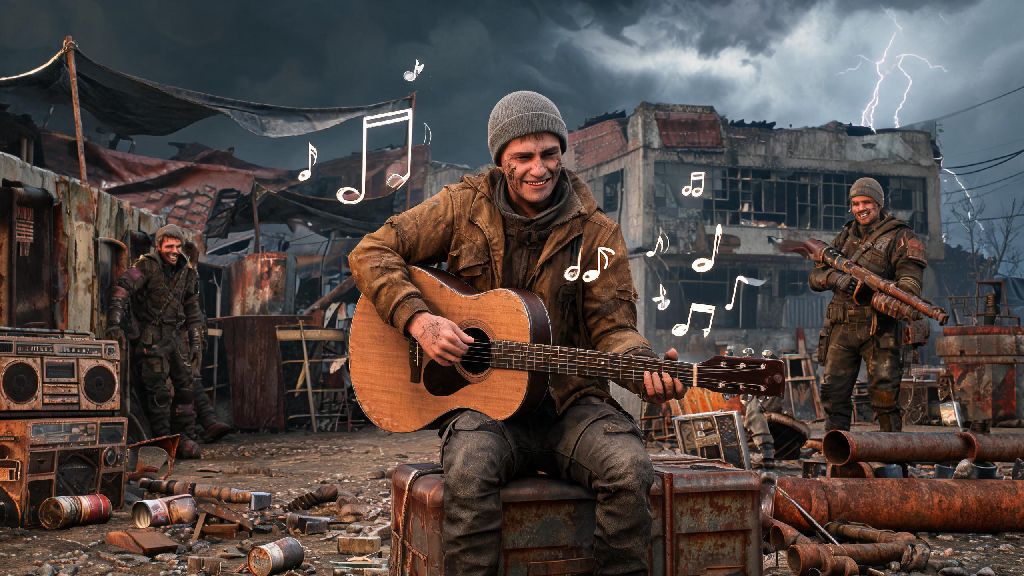
If you’ve spent any amount of time on public Rust servers, you’ve probably had the surreal experience of hiding from a roaming raid group only to hear someone strumming a half-decent version of Wonderwall from a nearby base. Most players write off instruments as a silly, useless gimmick at first, but learning how to play rust instruments is one of the most fun, underrated ways to get more out of the game. It doesn’t require any real-world music skill, either. You only need a few basic materials, a little bit of practice, and a willingness to look a little silly for your teammates.
First: Unlock and Equip Your Rust Instruments
You can’t just spawn into a fresh wipe and pull a guitar out of thin air, obviously. The first step to playing any instrument in Rust is getting access to its blueprint or crafting recipe. You can find instrument blueprints in regular loot crates at most low to mid-tier monuments, buy them for 10 to 30 scrap at the Outpost vending machines, or sometimes get them as random drops from toolboxes scattered along roads.
Unlock the corresponding blueprint first before you waste resources trying to craft an instrument, and make sure you have the required materials on hand. Early game, the acoustic guitar is your best bet, since it only requires 50 wood and 10 cloth to make. Higher-tier instruments like the piano or drum kit will need more rare materials like metal fragments or leather, and they’re usually only worth crafting once you have a stable, well-defended base.
There are five core playable instruments in the game right now, each with different use cases:
Keep your weapons holstered before equipping any instrument to avoid accidentally shooting your teammate mid-performance. You can’t hold a weapon and an instrument at the same time, so make sure you’re in a safe space before you pull out your guitar. I learned this the hard way when I accidentally shot my base’s storage chest while trying to switch from a shotgun to a trumpet, and lost 200 scrap in the process.
Core Steps to Learn How to Play Rust Instruments Smoothly
You don’t need to know how to read sheet music to play fun, recognizable songs in Rust. The default control scheme maps notes to the number row on your keyboard, with shift and modifier keys letting you switch between octaves. Most players don’t stick with the default controls for long, though, since they’re not optimized for simple melodies.
Bind your keys to notes that match simple, familiar songs first if you want to pick up the skill fast. For example, if you want to learn Happy Birthday, you can bind the four core notes of the song to the first four number keys so you don’t have to fumble with octave shifts mid-performance. You can adjust these bindings in the game’s control settings under the “Instruments” tab, and you can save different binding profiles for different songs if you want.
If you don’t feel like manually learning note patterns, you can also use MIDI input to play pre-made song files directly through your in-game instrument. That means you can pull almost any popular song file from the internet and play it perfectly in game, no practice required. But be warned: many PvP servers disable MIDI input to stop players from spamming loud, annoying songs to harass other teams or distract people during raids. Always check your server’s rules before you use MIDI files, or you might get kicked or banned.
Start with short, 2-3 note melodies before attempting complex tracks. Even if you can use MIDI, learning to play simple songs manually is way more fun, and it lets you improvise on the fly. I spent my first hour with a guitar just playing the first two notes of Seven Nation Army over and over, and my teammates still thought it was the funniest thing they’d heard all wipe. You don’t have to be a professional musician to have fun with it.
Fun, Practical Ways to Use Rust Instruments in Game
Instruments aren’t just for messing around at your base. They have actual, practical uses in regular survival gameplay, if you get creative with them. I’ve used instruments for everything from negotiating trade deals to avoiding fights with roaming groups, and it’s almost always worked better than trying to yell at people over proximity chat.
Playing a gentle, well-known song is one of the best non-verbal ways to signal you’re friendly when you run into other players out in the wild. Most people will assume anyone they see is going to shoot first, but if you pull out a guitar and play a few bars of a familiar song, they’re far more likely to lower their weapon and talk to you. I once traded a 10-minute performance of popular pop songs for enough low-grade fuel to run my base’s generators for three days, just because the other team was bored and liked my playing.
You can also use instruments to send signals to your team if you’re spread out across a large map. The trumpet’s sound carries almost twice as far as proximity chat, so you can set up simple code patterns to let your team know if you’ve found loot, if there are enemies nearby, or if it’s safe to move into a new area. It’s way harder for enemy teams to decode a trumpet signal than it is for them to intercept your team’s voice chat, if you’re playing on a server that allows chat interception.
Of course, you can also just use instruments to mess with people. I’ve hidden in bushes near enemy bases and played loud, annoying songs to distract them while my teammates snuck in to steal their loot, and it’s worked more times than I care to admit. Just don’t do it too often on the same server, or you’ll end up on every team’s kill on sight list. Ask me how I know.
Common Mistakes to Avoid When Playing Rust Instruments
For such a simple feature, there are a lot of small mistakes that can turn your fun instrument session into a disaster. Most of them are easy to avoid once you know what to look for, but new players make them all the time.
The biggest mistake is pulling out an instrument in an active PvP area. You can’t defend yourself while you’re holding an instrument, and the sound of you playing will draw every nearby player right to your location. Save the performances for your base, the Outpost safe zone, or areas you’ve already cleared of enemies. I once got sniped from 200 meters away because I decided to play a song while I was looting a roadside toolbox, and I lost all the scrap I’d been saving for a new assault rifle.
Never leave your instrument enabled when you suspect enemies are nearby. The sound of you accidentally pressing a key will give away your position way faster than your footsteps will, and you won’t be able to hear enemy movement over the sound of your own playing. If you hear gunfire or see signs of another team nearby, put your instrument away immediately and pull out your weapon.
You also don’t want to spam loud instruments on populated servers. Most servers have rules against excessive noise harassment, and if enough people report you for playing the same 10-second trumpet loop over and over for an hour, you’ll probably get kicked or banned. Keep your performances short and respectful if you’re in a shared public area like the Outpost, and save the loud, silly stuff for your own base where you won’t bother anyone else.
Finally, don’t waste rare resources on high-tier instruments early in a wipe. A piano might be fun to play, but it’s not worth spending 100 metal fragments on when you don’t even have a stone wall around your base yet. Start with the cheap acoustic guitar, and only upgrade to more expensive instruments once you have all the survival basics sorted out.
At the end of the day, Rust is a game about surviving against other players, but that doesn’t mean you can’t have a little fun while you do it. Learning how to play rust instruments is a great way to bond with your team, make friendly connections with other players, and take a break from the constant cycle of raiding and getting raided. You don’t have to be good at it, either. Even if you only know how to play two notes, your teammates will probably get a kick out of it, and you might even walk away with some extra scrap if you play your cards right. Next time you spawn into a new wipe, spend a few extra minutes tracking down a guitar blueprint. You won’t regret it.