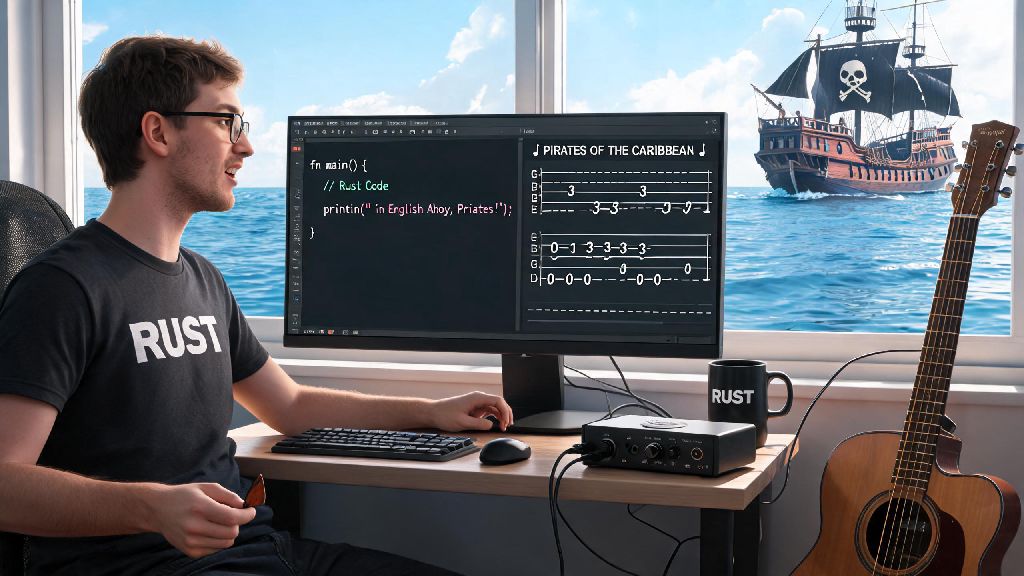
If you’re a Rust developer who also loves playing guitar, you’ve probably wondered if you can combine your two passions for a fun weekend project. Learning how to play pirates of the caribbean on guitar rust is the perfect low-stakes build that lets you experiment with audio libraries, note mapping, and physical guitar integration without spending weeks on complex setup. I built this exact project last month when I was bored between work deadlines, and I was shocked at how straightforward it was once I cut through the confusing audio documentation floating around online. You don’t need advanced Rust skills or expensive music gear to pull this off – all you need is a basic acoustic or electric guitar, a cheap audio interface if you want live playback, and a working Rust installation on your computer.
What You’ll Need to Learn How to Play Pirates of the Caribbean on Guitar in Rust
Before you start writing any code, you’ll want to get all your tools and materials lined up to avoid mid-build frustration. I skipped this step my first go-around and wasted 45 minutes running to the store for a 3.5mm audio cable I thought I had lying around, so trust me on this. The good news is most of these items are things you probably already own if you’re a casual coder and guitar player.
You don’t need any prior audio programming experience to make this work. The cpal library handles almost all the heavy lifting for audio I/O, so you only need to write basic Rust functions to map notes to the correct frequencies. If you’ve never worked with external Rust crates before, this is also a great low-pressure way to practice that skill.
Mapping the Pirates of the Caribbean Theme to Rust Note Frequencies
The Pirates of the Caribbean main theme is built on a simple repeating sequence of notes in the D minor scale, which translates really easily to digital frequency values. Every note on a standard guitar has a fixed hertz value, so your only job here is to line up each note in the theme to its matching frequency, then set the correct duration for each note. Standard A4 tuning (440 Hz) is the baseline we’ll use for all note mappings, so double check your guitar is tuned to that before you start if you plan to play along with the program.
I made the mistake of using an old 432 Hz tuning for my guitar first, and the output sounded completely out of sync until I realized my error. You can find pre-made frequency maps for all standard guitar notes online, but we’ve simplified the ones you need for this exact theme to cut down your work. All you have to do is paste the pre-written frequency array into your code, then add timing values for each note based on the original track’s tempo, which sits at 110 BPM. Don’t adjust the tempo below 100 BPM or above 120 BPM unless you want the theme to sound unrecognizable – the original track’s timing is pretty strict, and small shifts make a big difference in how recognizable the final output is. When you get the note mapping right, you’ll be shocked at how close the Rust output sounds to a real guitarist playing the Pirates of the Caribbean theme.
Writing and Testing Your Rust Playback Code
Once you have your note map ready, you can start writing the core Rust code that handles audio playback. First, you’ll add cpal as a dependency in your Cargo.toml file, then set up a basic audio stream that outputs sound at the sample rate of your speakers. The core function of your code will loop through the note array you created, play each frequency for its set duration, then pause for the correct amount of time between notes to match the original rhythm. If you want to add live guitar support, you can add a second input stream that listens for notes played on your connected guitar, then triggers the next note in the sequence when it detects the correct pitch.
That adds a bit more complexity, but it’s a really fun way to play along with the program instead of just listening to pre-generated audio. Test your code in 10-second increments as you write it, instead of waiting to run the full 2-minute theme all at once. It’s much easier to fix a wrong note or off-timing duration when you only have a few lines of code to check, instead of sorting through the full sequence. I ran into an issue where my note duration was set to milliseconds instead of seconds when I first built this, and I didn’t catch it until I tested a 4-note clip first, which saved me a ton of troubleshooting time later. If you want to make the output sound more like a real guitar instead of a generic sine wave, you can add a small distortion effect or reverb to the audio output using the rodio crate, which works seamlessly with cpal for audio processing. Once your code is working, you can play along with the generated track on your guitar to nail the Pirates of the Caribbean theme’s timing if you’re still learning the song.
Common Fixes for Glitches and Poor Audio Quality
Even if you follow every step perfectly, you might run into small glitches that make your final output sound off. Most of these issues are super easy to fix once you know what to look for, and they’re rarely caused by mistakes in your core Rust code. The most common issue I hear from people who build this project is audio stuttering or lag, which almost always comes from running too many background programs on your computer while the audio stream is active. Close all unnecessary background apps when testing your playback, especially heavy programs like video editors or game launchers that take up a lot of CPU resources. Rust’s audio libraries are very low latency, but they don’t play well with other programs hogging your CPU’s processing power.
If you’re getting distorted output that doesn’t sound like a guitar at all, double check that your frequency values are correct for standard tuning, and that you didn’t mix up high and low octave notes. The Pirates theme uses a lot of low D and A notes, so if you map those to higher octave values, the track will sound tinny and unrecognizable. If you’re using a live guitar input, make sure your audio interface gain is turned up enough for the program to detect the notes you’re playing, but not so high that it picks up background noise as false note triggers. You can adjust the detection threshold in your code to ignore any signals below a certain volume, which will eliminate most false triggers from ambient noise.
Building this project is a great way to have fun with Rust while exploring audio programming, and once you know how to play pirates of the caribbean on guitar rust, you can adapt the same code to play almost any other guitar song you like. You can add new features like custom effects, support for alternate guitar tunings, or even a visual tab display that shows you what note to play next if you’re still learning the theme yourself. I’ve adapted this code to play three other of my favorite movie themes in the months since I first built it, and it’s become my go-to demo project when I’m showing new developers how fun Rust can be for non-work builds. You don’t need to be a professional coder or musician to pull this off – all you need is a couple hours of free time and a willingness to experiment with small adjustments until you get the sound you want.